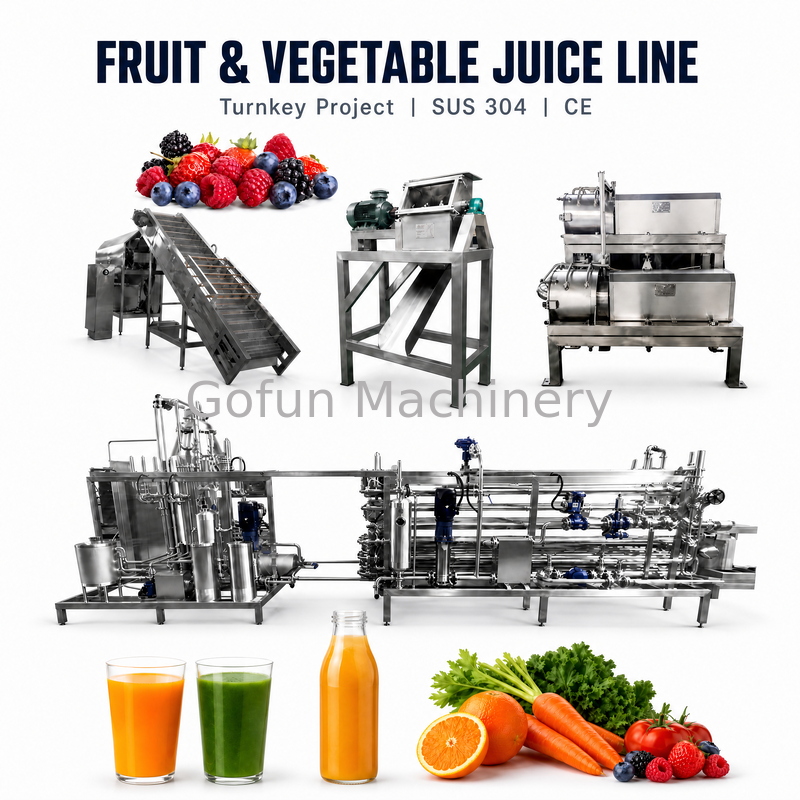
This juice beverage processing line is built around the blending section, where juice concentrate or NFC base is adjusted to a target Brix-acid ratio before filling—the stage that determines whether a beverage tastes consistent from batch to batch, and the stage most often left to manual operator judgment on lines designed primarily for single-strength juice.
The blending section uses inline refractometry and pH measurement on the base juice stream, feeding a controller that calculates the required additions of water, sugar syrup, and acidulant. The additions are made by mass-flow-controlled dosing pumps rather than volumetric cups, so the ratio holds regardless of base juice concentration variation. The controller logs the calculated ratio and the actual measured ratio after blending, and a batch that falls outside the recipe window is diverted to a hold tank rather than proceeding to pasteurization.
For beverage products containing added flavors, vitamins, or functional ingredients, the line provides a post-blending dosing point positioned after the Brix-acid adjustment but before the deaeration stage, so heat-sensitive additives are not exposed to the higher temperatures of the upstream juice treatment. The dosing point is sized for low-volume addition and is flushed automatically between batches.
The pasteurization section is matched to the blended product's characteristics rather than to a fixed setpoint: the holding tube's residence time and temperature are recipe parameters, because a sweetened beverage with higher solids requires different thermal treatment than single-strength juice. The filler is configured for glass, PET, or can formats with format-specific change parts, and the CIP circuit covers the blending and dosing sections separately from the pasteurizer. This configuration suits beverage producers running multiple drink SKUs from a common juice base, where blend consistency and additive integrity are the quality constraints.


 Home
>
PRODUCTS
>
Vegetable Processing Line
>